Investment memo
3. Detailed Memo
Plumbline
The AI preconstruction copilot for commercial general contractors. It reads the drawing set, generates a quantified takeoff, and assembles a priced bid the estimator reviews instead of builds.

RoundSeries A
Ask$15M at $45M pre
DateJuly 2026
MEMO · 01 / 16
Cover
Plumbline is the AI preconstruction copilot for commercial general contractors. It reads the drawing set, generates a quantified takeoff, and assembles a priced bid the estimator reviews instead of builds.
Preconstruction is the front of every construction project. It is where the number that wins or loses the job gets built, and it is still done by hand. Plumbline automates the grunt work and leaves the judgment to the estimator.
The company was founded in 2024 and sells to commercial general contractors in the United States. This memo covers the problem, the product, the market, the model, the team, the numbers, and the terms of the Series A.
M 01 / 16

MEMO · 02 / 16
Problem
Preconstruction is still manual. Estimators hand-measure quantities off PDF drawings, then assemble bids in spreadsheets. The work is slow, repetitive, and easy to get wrong.
More than 40% of an estimator's hours go to takeoff and data entry, not judgment. That is time spent counting, not deciding which jobs to chase or how to price the risk.
The people who do this work are retiring. Senior estimators are leaving faster than firms can replace them, and the cost knowledge in their heads walks out the door with them.
So general contractors bid less work than they should. They no-bid good jobs because they cannot staff the takeoff, win rates suffer, and margins get guessed instead of measured. The bottleneck is not pipeline. It is the people-hours locked in the takeoff.
M 02 / 16
MEMO · 03 / 16
Solution
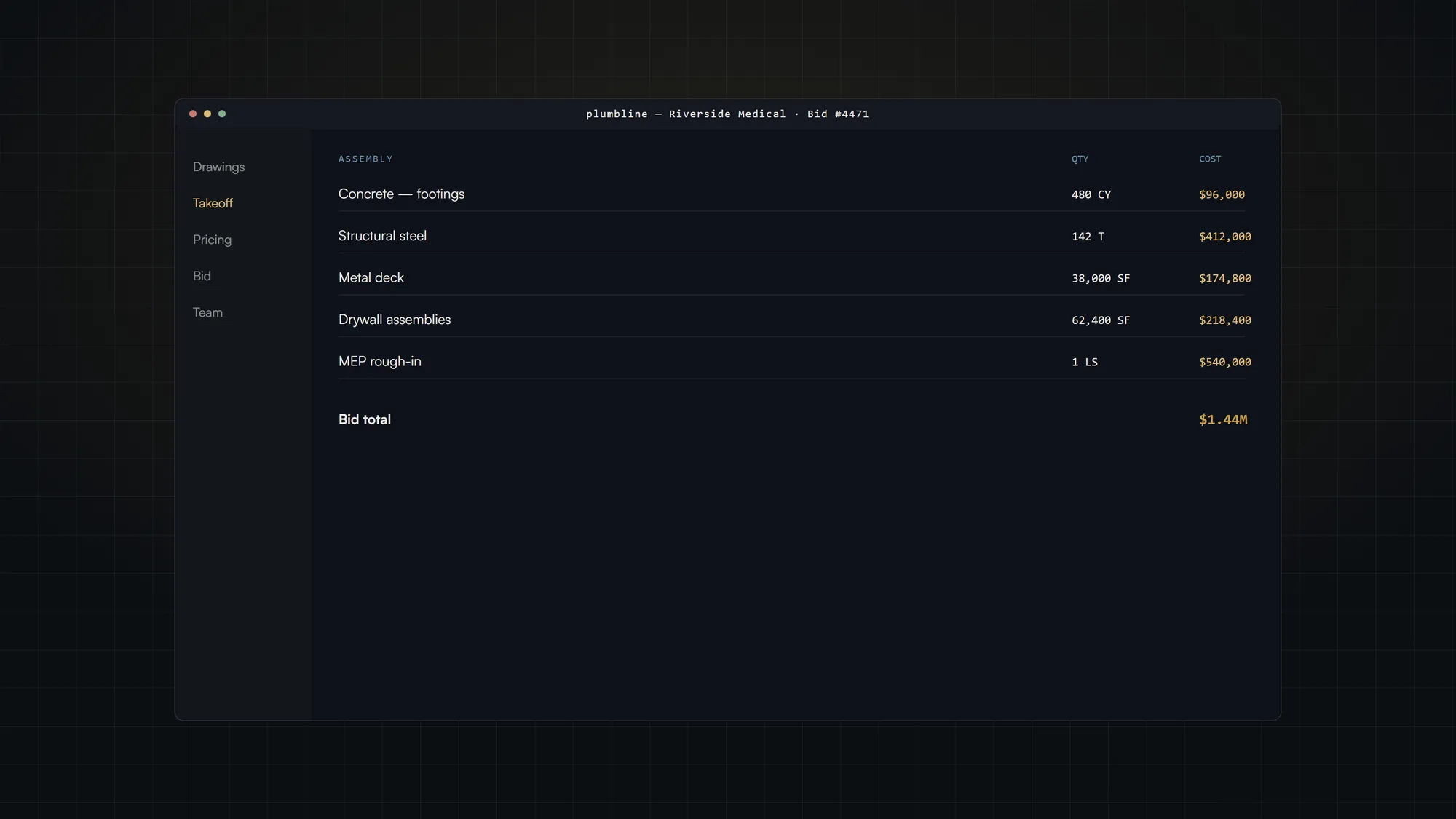
Plumbline reads the full drawing set and produces a quantified takeoff in hours, not weeks. It prices that takeoff against the firm's own historical cost data and assembles a bid-ready package.
The estimator stays in charge. They review the quantities, adjust the assumptions and margins, and sign off on the number. Every figure traces back to a sheet in the set, so nothing is a black box.
This is human in the loop by design. The judgment stays with the estimator. The grunt work goes to the machine.
M 03 / 16
MEMO · 04 / 16
Product
Plumbline is a preconstruction workspace. Drawings go in, and a quantified, priced bid comes out. It is one place for the whole precon team to work a project, versioned as the drawings change.
It fits the tools general contractors already run. Plumbline connects to Procore, Autodesk Construction Cloud, Bluebeam, and the spreadsheets estimators live in, so adopting it does not mean replacing the rest of the stack.
Every project is tracked, every version is kept, and every number is traceable. The workspace is built for the way precon teams actually work.
M 04 / 16
MEMO · 05 / 16
How it works
Plumbline runs the preconstruction workflow in five steps.
First, it ingests the drawing set and specs, whether PDF or DWG. Second, the AI performs the takeoff: it detects and quantifies assemblies such as concrete, steel, drywall, and MEP rough-in, and tags each by location. Third, it prices the takeoff against the firm's historical cost database and live material feeds. Fourth, the estimator reviews, adjusting quantities, assumptions, and margins, with every number traceable to a sheet. Fifth, Plumbline assembles the bid and exports it in the firm's own proposal and estimate format.
The outcome is simple. A drawing set becomes a defensible bid in a day, not three weeks.
M 05 / 16

MEMO · 06 / 16
Value proposition
There are three ways general contractors handle preconstruction today, and each falls short.
Manual, in-house estimating is accurate but slow, and it does not scale past the people you can hire. Legacy takeoff tools like Bluebeam and PlanSwift speed up measuring but still leave the estimator to do the counting and the pricing by hand. Horizontal AI copilots are fast but know nothing about construction drawings or a firm's cost history.
Plumbline is built for this job. It is construction-native AI that produces a quantified takeoff rather than just a measurement, prices it against the firm's own cost intelligence, assembles the bid end to end, and keeps a human in the loop so every number is auditable. No alternative combines all four.
M 06 / 16
MEMO · 07 / 16
Features
Plumbline ships five capabilities that matter to a precon team.
AI quantity takeoff detects and measures assemblies straight from the drawing set. Historical cost intelligence prices the work from the firm's own closed jobs, not a generic RSMeans table, so the numbers reflect how this firm actually builds. Bid assembly and export produce a proposal-ready package in the firm's format. Team collaboration puts the whole precon team on one project, versioned as drawings change. Integrations connect to Procore, Autodesk Construction Cloud, Bluebeam, and spreadsheets.
Together these turn preconstruction from a manual grind into a reviewed, repeatable process.
M 07 / 16

MEMO · 08 / 16
Why now
Three things make this the moment for Plumbline.
First, the labor is disappearing. The construction workforce is short, and senior estimators are retiring faster than firms can replace them. The work has to get done with fewer people.
Second, the capital is here. Construction technology has drawn record funding, and general contractors are more willing to buy software than they have ever been.
Third, the technology finally works. AI can now read and reason over a full drawing set, which was not possible a few years ago. The problem and the tool have arrived at the same time.
M 08 / 16
MEMO · 09 / 16
Market
The market is large and the wedge is specific.
Global construction estimating and preconstruction software and services is a $28B market. Narrowing to United States commercial general contractor preconstruction software, the serviceable market is $6.5B. Plumbline's own Year-5 revenue target, the share it plans to capture, is $48M.
This is not a thin niche that has to be invented. Every commercial general contractor already spends money and hours on preconstruction. Plumbline sells into an existing budget and does the same job faster and cheaper.
M 09 / 16
MEMO · 10 / 16
Business model
Plumbline sells seats plus usage. A seat is $2,400 per year, and usage is charged per drawing set processed. The pricing tracks the value delivered: more bids run means more seats and more usage.
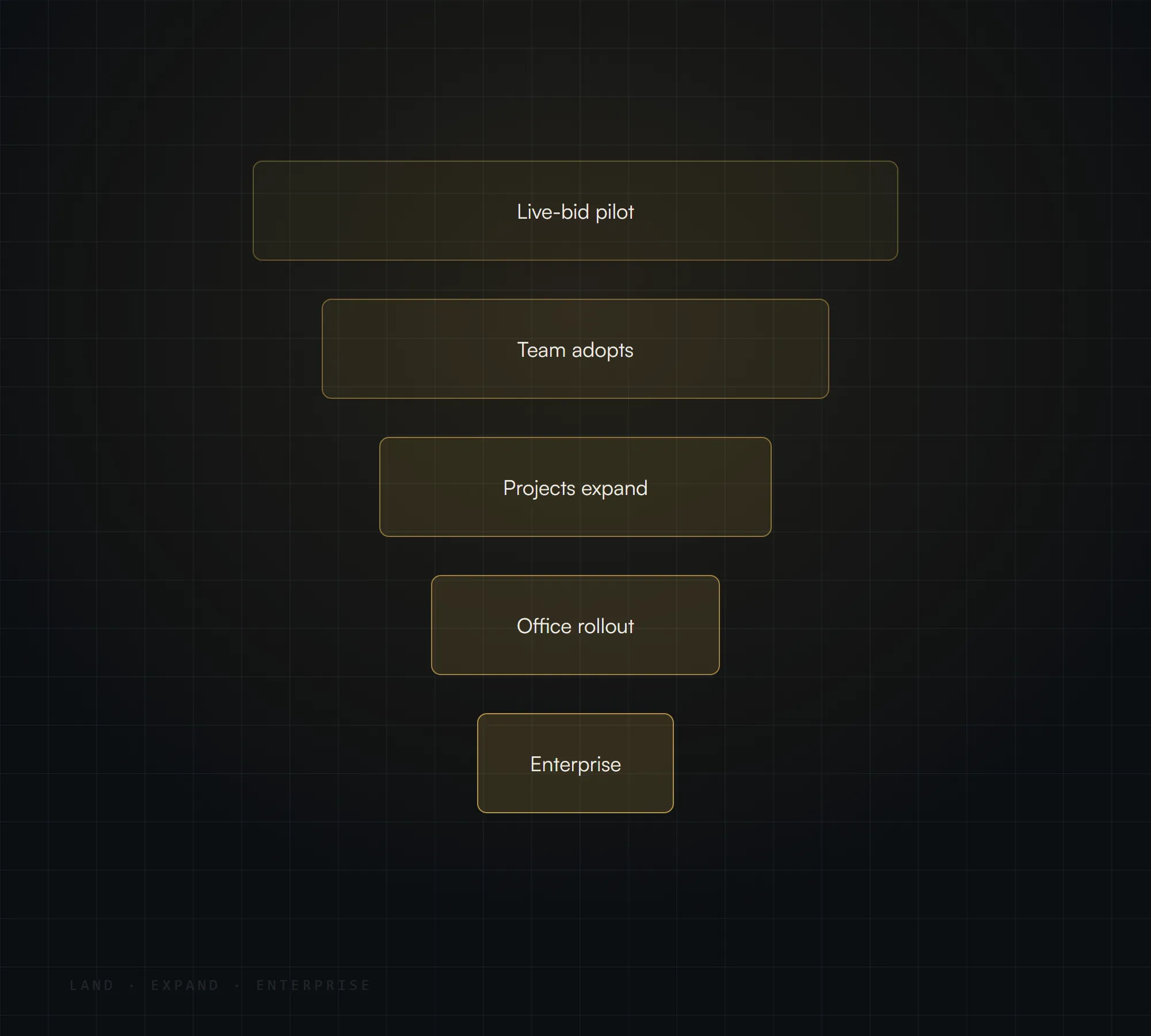
The motion is land and expand. Plumbline lands with a single preconstruction team on a live bid, then expands across the general contractor's project teams and offices. Average revenue per account grows as that happens, from $70K to $89K to $100K to $123K to $141K over the plan.
Net revenue retention runs from 118% to 132%. Existing customers spend more each year, so growth compounds on top of a base that is expanding on its own.
M 10 / 16
MEMO · 11 / 16
Go to market
Plumbline reaches general contractors five ways.
It lands with a single precon team on a live bid, which pays back inside one bid cycle and proves the value fast. It expands by project and office inside the general contractor, growing seats and usage. It runs an enterprise motion into ENR-400 firms, where it already has three enterprise logos. It builds an estimator community and channel through preconstruction associations and referrals. And it uses the Procore and Autodesk integration marketplaces as a distribution surface.
Blended CAC payback is 14 months, and the land motion pays back inside a single bid.
M 11 / 16
MEMO · 12 / 16
Team
Plumbline is built by people who have done this job.
Marcus Reyes, CEO, was preconstruction lead at a top-25 ENR general contractor and has 15 years estimating. Priya Nandakumar, CTO, came from Autodesk and Procore and built computer vision on construction documents. Daniel Okafor, Chief Product Officer, built estimating tools at Bluebeam. Sarah Whitfield, VP Revenue, scaled vertical-SaaS go-to-market into the AEC market.
The founders know the customer, the drawings, and the sale. This is not a general AI team learning construction. It is a construction team that can build AI.
M 12 / 16
MEMO · 13 / 16
Competitive advantage
The market splits on two axes: construction-native and AI-native. Most players sit on one axis or neither.
Legacy takeoff tools like Bluebeam and PlanSwift are construction-native but not AI. Horizontal AI copilots are AI-native but know nothing about construction. In-house and manual estimating is neither. Plumbline is the only one that is both.
Four things hold the position. Plumbline is trained on drawing sets. The firm's own cost data becomes a moat that deepens with use. The product runs end to end, from takeoff to bid, not just one step. And it keeps a human in the loop, which is the auditability enterprises require before they trust a number.
M 13 / 16
MEMO · 14 / 16
Roadmap
The plan moves in three phases.
Now, Plumbline does AI takeoff and bid assembly, with 40 paying general contractors and 3 ENR-400 logos. Next, it deepens the cost intelligence, ships Procore and Autodesk integrations, adds enterprise SSO and security, and opens an estimator marketplace. Later, it becomes the full preconstruction operating system, covering scheduling, risk, value engineering, and subcontractor bid leveling.
Each phase expands the account. The takeoff is the way in. The preconstruction OS is the destination.
M 14 / 16
MEMO · 15 / 16
Forecast
The numbers compound over five years.
Revenue grows from $2.8M to $48M, roughly 17 times over the plan. Paying general contractors go from 40 to 340, and average revenue per account rises from $70K to $141K. Gross margin improves from 68% to 78% as the product scales. The business turns EBITDA-positive in Year 5.
The number that matters most is unit economics. LTV to CAC improves every single year, from 1.2x to 5.4x, and CAC payback falls from 18 months to 11. Net revenue retention holds between 118% and 132%. The base today is 40 paying general contractors, 3 ENR-400 logos, $2.8M ARR, and 132% net revenue retention.
M 15 / 16
MEMO · 16 / 16
Ask
Plumbline is raising $15M in Series A at a $45M pre-money valuation. That is a $60M post-money and 25.0% dilution.
The pre-money is supported by a six-method valuation that lands in a $40M to $50M band and weights to $45.0M. It is not a single-model number. Berkus, Risk Factor Summation, Scorecard, the VC Method, DCF, and First Chicago all point at the same range.
The money goes to four places: product and R&D on the drawing AI and cost intelligence, go-to-market for enterprise and expansion, integrations and security, and general and administrative. The plan takes Plumbline from $2.8M to $48M in revenue and to EBITDA-positive in Year 5.
M 16 / 16